Anthropic reported a Claude chat to the police: are your AI conversations private?
A Florida woman wrote in Claude that she would attack a sheriff's office; someone at Anthropic read it and called the police. Here's what happened, when someone can read your AI chats, and what a business in Galicia should do.
 By Miguel A. Taboada
· 5 min read
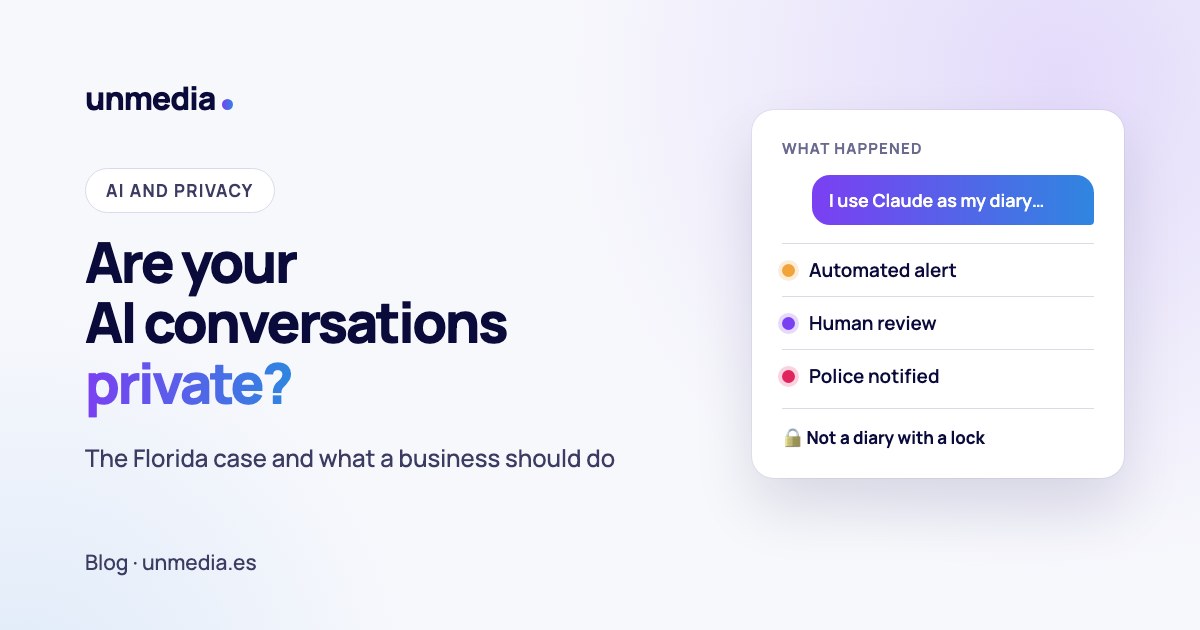
Not entirely. In late September 2026, a Florida woman who used Claude "like a diary" wrote that she was going to "shoot up" the sheriff's office. Anthropic's safety systems flagged the conversation, a person at the company reviewed it, judged it a credible threat and alerted the police, who detained her at home. Nobody routinely reads your chats with Claude, ChatGPT or Gemini, but they can be reviewed if the systems detect a serious risk, and the company can share them with the authorities.
People tell AI things they wouldn't tell anyone: health problems, relationship rows, client data, the draft of a dismissal letter. This case is a reminder of something that has been in the small print for a while: a chatbot conversation is not a diary with a lock. Here are the facts as reported and what they mean if you use AI at work.
What exactly happened?
According to the arrest report as covered by TechSpot, Futurism and Yahoo News, the timeline is:
| When | What happened |
|---|---|
| 26 September 2026 | A 30-year-old woman from Bonita Springs, Florida, writes in Claude that she is going to "shoot up" the Lee County Sheriff's Office. |
| Early hours of the 27th | Another message follows: she says she has a new gun and calls it a "last chance". |
| Then | Claude's automated systems flag the conversation and escalate it to human review. A person at Anthropic judges it a credible threat and notifies the authorities. |
| Arrest | Deputies go to her home and detain her without incident. According to Sheriff Carmine Marceno, she admitted using Claude "like a diary", unaware that someone at the company could read it. |
She is charged with making a written threat to kill or do bodily harm under Florida Statute 836.10, a second-degree felony. The law covers written or electronic threats sent in a way that another person can see them.
Note: this is an accusation. She is presumed innocent unless a court finds otherwise.
Can someone read my conversations with Claude?
Yes, in specific cases. Anthropic's privacy policy is clear about it:
- Safety review. Conversations the systems flag as potentially harmful can be reviewed and are kept longer to improve abuse detection.
- Disclosure to authorities. Anthropic may share data with the authorities if it believes in good faith that it's needed to comply with the law or to prevent serious harm to someone. In emergencies, when it believes it's necessary to prevent death or serious physical injury.
- Training. On consumer accounts (Free, Pro and Max), conversations may be used to train the models unless you switch it off in settings. Anything flagged for safety is used regardless.
- Deletion. If you delete a conversation, it disappears from your history immediately and from the servers within 30 days.
OpenAI has said it does something similar with ChatGPT: automated scanning, human review when an alarm goes off, and referral to the police for serious threats against others. In fact, OpenAI has faced criticism and lawsuits for the opposite: failing to warn in time in cases of violence.
Did Anthropic do the right thing?
There are two readings, and both are partly right.
- Yes, it was a specific threat. A place, a weapon and a "last chance". Had the company kept quiet and something happened, the criticism would have been far harsher.
- But it's unsettling. The user thought she was writing to herself. Someone venting to an AI at a bad moment can end up with their conversation in a stranger's hands. Where venting ends and a threat begins comes down, in the end, to an employee's judgement.
The practical takeaway doesn't depend on which reading you prefer: what you type into a chatbot is stored by a company and, in certain cases, a person can read it.
What does it mean for a business?
That AI is not a locked drawer. If you or your team use Claude, ChatGPT or Gemini at work, three tips:
- Don't put client personal data into a personal account. Names, ID numbers, medical records or payslips don't belong in a free chat. If you process them, the GDPR requires you to know where they end up, and a consumer account doesn't give you that control.
- Use business plans or the API. Business plans (Claude Team or Enterprise, ChatGPT Business or Enterprise) and API usage are governed by a contract, don't train on your data by default, and let you sign a data processing agreement. For highly sensitive data, you can also run an AI on an office computer, with nothing leaving the building.
- Write down a rule. Which tools may be used, with what data and from which accounts. One page is enough. If a client or a data protection authority ever asks, you'll have it to hand.
If you want to bring AI into your business with everything in order, for example an assistant that answers your customers without their data ending up where it shouldn't, I can help. Ask me for a quote.
Frequently asked questions
Does Anthropic read my conversations with Claude?
Not routinely. Only conversations the automated systems flag as potentially harmful, or ones you report yourself, are reviewed.
Can Claude alert the police?
Yes. Anthropic may share data with the authorities when it believes it's necessary to prevent death or serious injury, as in the Florida case of September 2026.
Are my ChatGPT conversations private?
Same as with Claude: nobody reads them as a matter of course, but they can be reviewed if a safety alarm goes off and the company can hand them to the authorities.
How do I stop Claude training on my conversations?
In your account's privacy settings you can turn off the use of your chats to improve the models. Business plans and the API don't train on your data by default.
Can a business use Claude or ChatGPT with client data?
Yes, with a business plan or the API, a signed data processing agreement and a clear internal rule. With a free personal account, better not.
Miguel A. Taboada
I design and build websites, apps and useful AI from Vigo, Spain. I write about what I see every week looking after websites for artists, schools and small businesses.